
Yes, you can charge a home battery overnight on a cheap tariff. On a time-of-use tariff the battery fills up in a low-price overnight window, then runs the house through the 4pm–7pm peak, when grid electricity costs the most. Add solar and it also stores the daytime surplus you would otherwise export. Below: how the tariffs compare, what one overnight charge is worth at today’s prices, and what to check before you plan a battery around a tariff. For homeowners with panels, or weighing them up, it is the difference between a battery that works in summer and one that earns its place all year.
Why a battery changes what your solar is worth
The case for storage starts with what happens to the solar you don’t use:
Without storage, any solar you don’t use immediately gets exported. A battery captures that surplus and powers your evenings — typically lifting self-consumption from ~30% to 70–90% and slashing grid imports.
Self-consumption is the share of your solar generation you use in your own home rather than export. Every unit you use yourself is a unit you don’t buy from the grid at your import rate, which is why moving from around a third of your generation to most of it makes such a difference to how hard the panels work for you. A time-of-use tariff adds a second source of cheap energy for the battery: the grid itself, at night.
How a time-of-use tariff works
A time-of-use (TOU) tariff charges different prices at different times of day. Tariffs like Octopus Go, Cosy and Intelligent Octopus give you cheap windows — often 7p–10p/kWh overnight — and pricier peaks. Prices move, so treat any figure as a snapshot at the time of writing and check the current rate for your region.
The windows differ between tariffs. According to Octopus Energy’s own pages, Octopus Go’s cheap electricity runs between 00:30 and 05:30 every night. Intelligent Octopus Go offers up to six hours of off-peak electricity for the whole home between 11:30pm and 5:30am. Cosy Octopus has three cheap windows a day and a peak between 16:00 and 19:00, with its rates set against the day rate in your region.
Cheap overnight tariffs compared
Each tariff sets its own cheap hours and its own conditions. The battery’s charging schedule has to match the window you are actually on.
| Tariff | Cheap window | What it asks for |
|---|---|---|
| Octopus Go | 00:30 to 05:30 every night | An electric car you charge at home, and a smart meter |
| Intelligent Octopus Go | Up to six hours between 23:30 and 05:30 | A compatible car or charger, and a smart meter |
| Economy 7 | Seven hours at night, set by your meter and supplier | A two-rate (Economy 7) meter |
The windows and conditions above are taken from Octopus Energy’s own pages at the time of writing; other suppliers run their own versions with different hours. Whether one window fills the battery depends on the inverter’s charge rate as well as the battery’s size, so the two are sized together.
What one overnight charge is worth
The saving comes from the gap between the overnight price and the price you would otherwise pay in the evening. Octopus quotes off-peak electricity on Intelligent Octopus Go from 6.5p/kWh. Ofgem’s price cap puts the average Direct Debit unit rate for October to December 2026 at 26.32p/kWh.
| 10 kWh at the off-peak rate | 10 kWh at the price-cap rate | |
|---|---|---|
| Unit price | 6.5p/kWh | 26.32p/kWh |
| Cost of 10 kWh | About 65p | About £2.63 |
At those two prices, a 10 kWh charge taken overnight and used in the evening is worth roughly £2, less the small amount lost in charging and discharging. That is an upper figure for one full cycle, not a promise: it shrinks if the battery isn’t emptied each evening, and your own rates depend on your region and your tariff. The savings calculator is the quicker way to see what your usage and roof point to.
A day on a time-of-use tariff
With a battery you charge cheap and discharge expensive — even in winter when solar is low. A typical daily pattern looks like this:
- Charge the battery on a 5-hour cheap window overnight
- Discharge it across the 4pm–7pm peak when grid prices spike
- Top up from your own solar during the day
The battery’s charge and discharge times are set to match the tariff, and the panels add to it through the day. On a bright day, stored solar can carry the house well into the evening. On a grey one, the overnight charge does more of the work.
Winter is when the tariff earns its place
A battery is often thought of as a summer upgrade, but the tariff side matters most when solar is weakest. In December the panels may add little, yet the battery can still charge in the cheap overnight window and run the house through the evening peak. That’s the practical difference between a battery that only stores surplus solar and one set up around a TOU tariff: the second stays useful all year round. Around Weston-super-Mare, PVGIS puts a south-facing kilowatt’s June output at close to four times its December output, as our solar panels in Somerset and North Somerset page shows month by month.
Can you charge a solar battery from the grid at night?
Yes. A hybrid inverter can be told to charge its battery from the grid during a set window, not only from the panels. That is what makes a solar battery useful on a cheap overnight tariff: the same battery that soaks up spare daytime solar also takes a full charge at the night rate when the panels have little to give.
The setting usually sits in the inverter’s app as a timed charge with a target level. In winter it makes sense to fill the battery overnight. In summer, a lower overnight target leaves room for the next day’s solar, so you aren’t paying for grid electricity the panels would have supplied. The schedule is set when the system is commissioned, and it can be changed later in the app.
Check the tariff’s rules before you plan around it
Not every home can join every tariff. On Octopus Energy’s own pages, Octopus Go asks that you have an electric car you charge at home, and Intelligent Octopus Go needs a compatible car or charger. All of them rely on a smart meter, and other suppliers set their own conditions.
So before sizing a battery around a particular price, check which tariffs your home can actually join. Prices and windows also change over time, so the battery design should still make sense if you switch tariff later. If an EV tariff is the one you want, a smart home EV charger can be scheduled into the same cheap window as the battery.
Backup is designed in, not automatic
Most modern hybrid systems offer Emergency Power Supply (EPS) — when the grid drops, essential circuits stay live from the battery, often with solar still charging it. But backup isn’t automatic with every battery. What can run in a power cut depends on the equipment and your home’s loads, and your design sets out exactly what stays on. Our guide to whether solar batteries work in a power cut goes through the options.
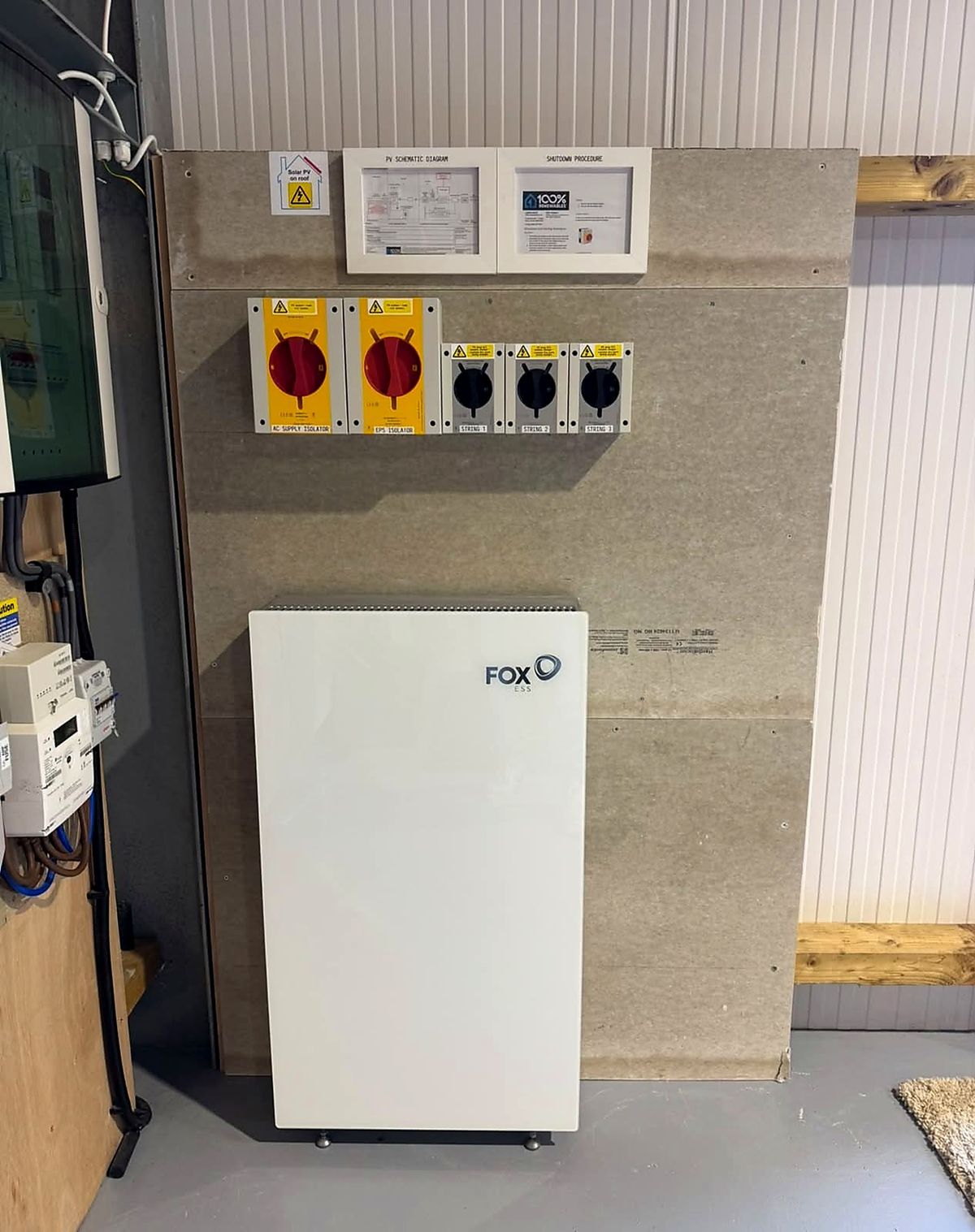
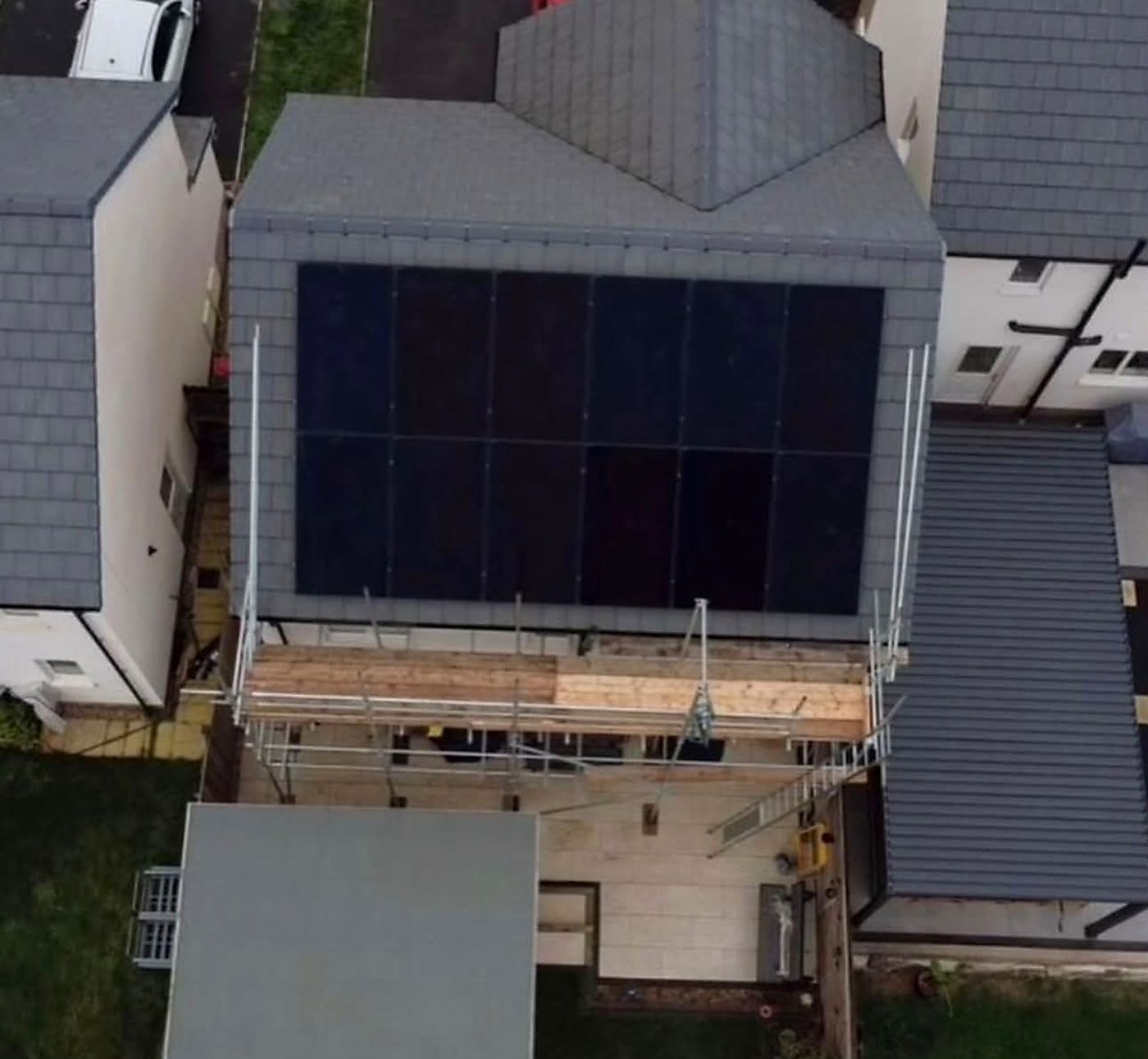
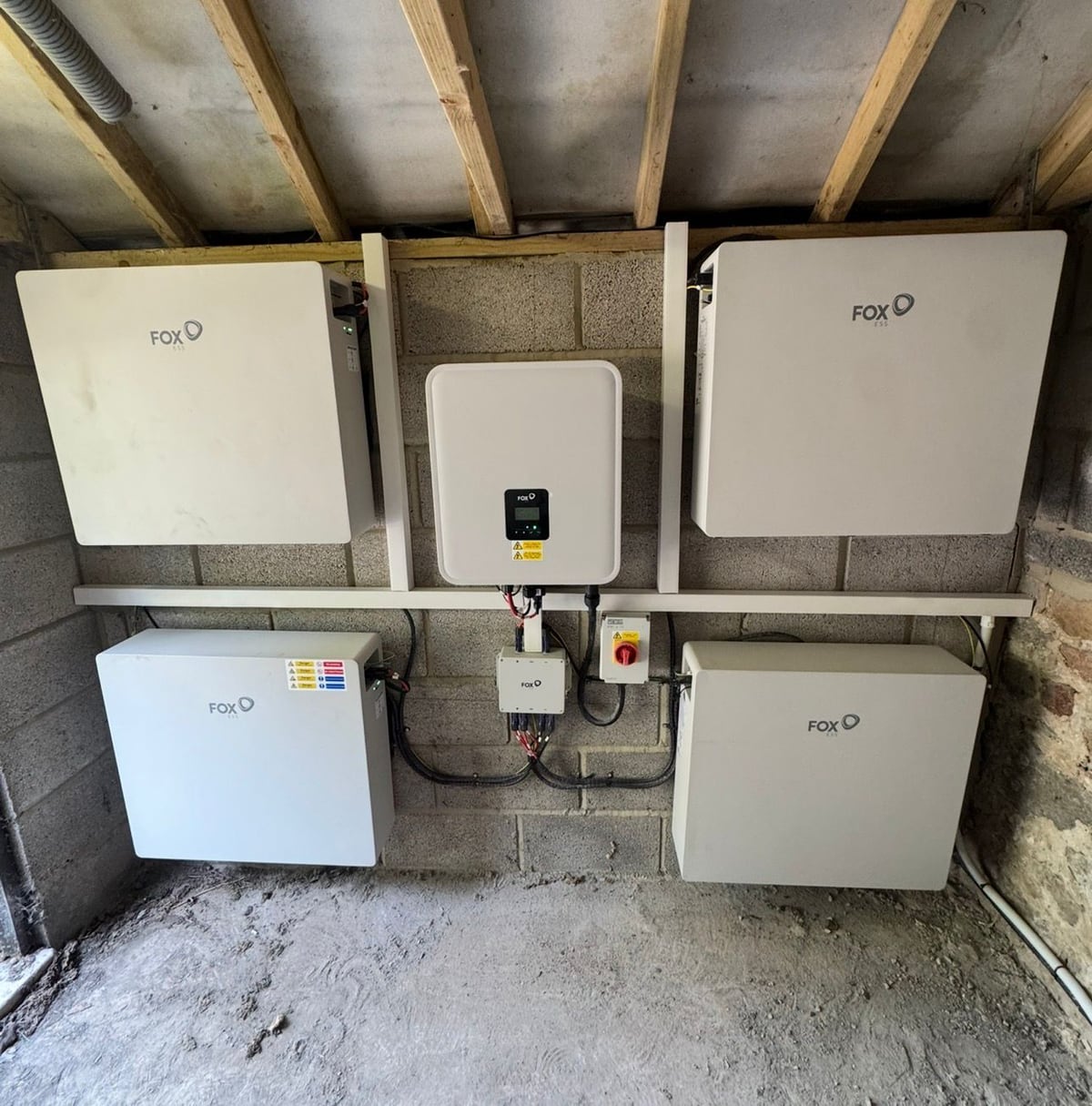
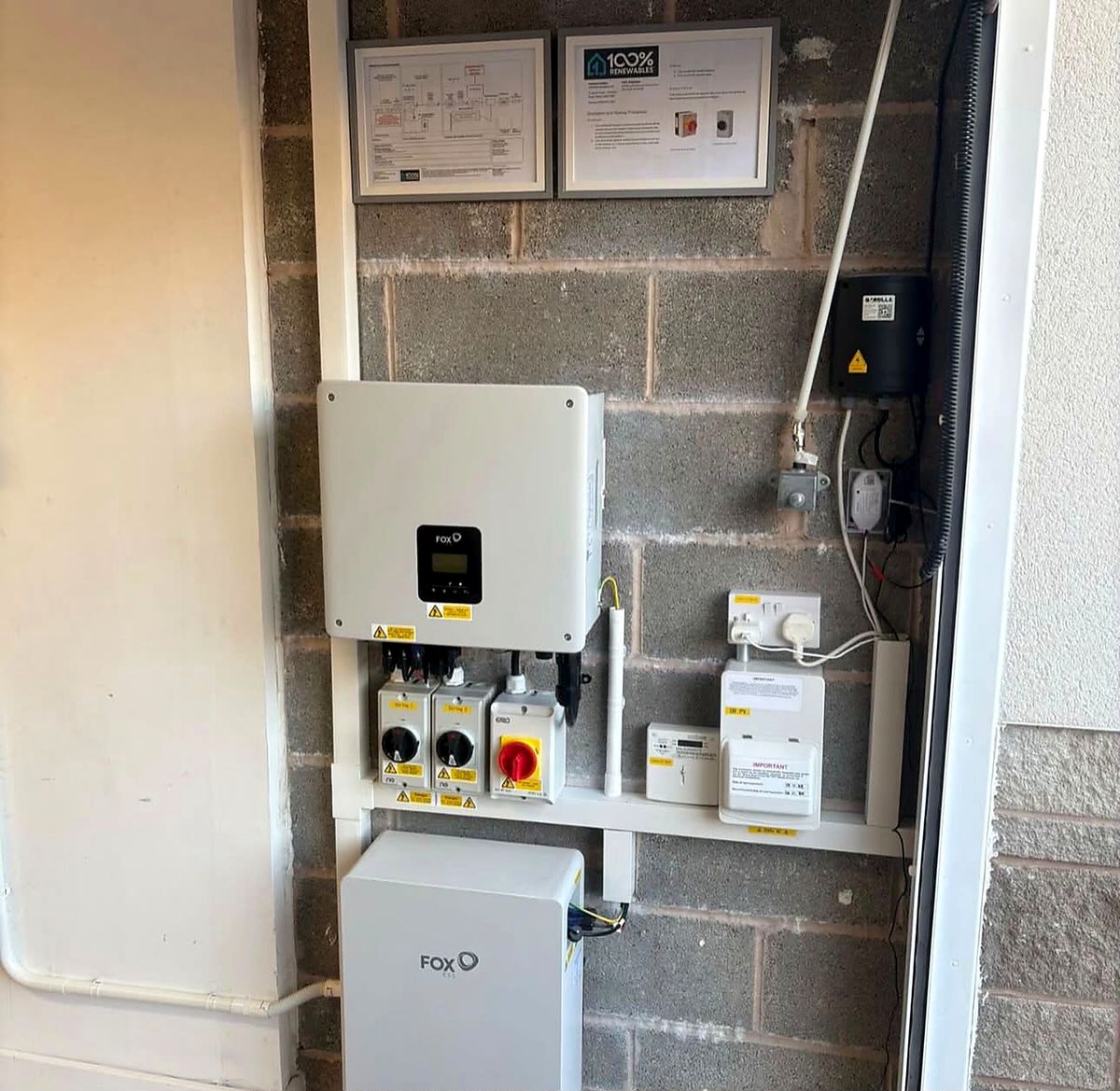
At our Shiplate install in Bleadon, a 10 kWh Fox ESS battery with AC/EPS changeover sits alongside a 12 kW all-black array, with three-string DC isolation and a PV schematic and shutdown procedure issued at handover. Whole-home backup is also possible with the right equipment: our London install pairs a Sigenergy battery configured for whole-home backup with a Sigenergy EV charger.
Start small, add modules later
Modern modular systems let you add extra battery modules years later as your needs change — buying an EV or just wanting more backup. We always size the inverter with headroom for expansion, and our home systems run from 5 to 30 kWh. That means you can start with the capacity you need now and add more if your household changes.
Batteries are also zero-rated for VAT on home installations until 31 March 2027, including retrofits to existing solar — our guide to 0% VAT explains what the relief covers.
Keep the settings matched to your tariff
A battery on a TOU tariff is only as good as its settings. Suppliers adjust prices and windows, and a schedule set for last year’s tariff can charge or discharge at the wrong times without anyone noticing. More kit means more firmware, more settings and more tariff optimisation opportunities, and a maintenance plan keeps every component talking, updated and tuned to your current tariff.
We commission systems onto a single app where possible, so one screen shows generation, battery state and grid flow. We’re a Fox ESS Registered Installer, and Fox ESS battery storage is on our Shiplate and Haywood Village home installs. If you drive an EV too, read our post on smart EV charging with solar — including how to stop the car draining the home battery.
Planning a battery around your tariff
See our home battery storage page for system sizes and backup options, pair it with solar panels, or estimate your figures with the savings calculator. When you’re ready, book a site survey. Tariff prices and windows quoted here are time-sensitive, so check your supplier’s current rates before you decide.